
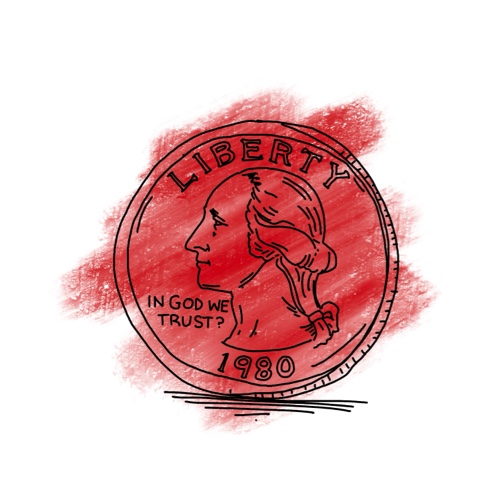
As a kid, my grandfather and I would adventure to different places in Southern California. From the tide pools at Dana Point to the rolling hills of Irvine, we found beautiful places to explore and talk about. One of the places that I loved going to was Balboa Island because it had carnival games. An added bonus, he had a friend from the high school they taught at, Mr. John, that would give me special tokens to play the games. They were quarters painted red so that when it’s time for collecting all of your profits as the carnival businsess, they would know that the red painted quarters went back to the house and that the unpainted quarters were profit.
Over the years, my grandfather insisted that I get to know Mr. John, not just for the quarters, but for his friendship. Mr. John would come to my grandparents house for lunch and dinner sometimes, and we would go meet him at Balboa Island. He told me about his stories, his struggles, and which games were the easiest and gave the best prizes. I enjoyed Mr. John. He was kind, different, generous, and he never treated me like a token because he knew what it was like. Mr. John was born with physical differences. At the time, when I was maybe 8 years old, he was the same height as I was. His body was shaped differently and he had endured many surgeries in order to help him have a full life. We were different together.
What I didn’t know then, that I have matured to understand now, is that the way that people approached me, talked to me, made assumptions about me, were sometimes attempts to paint me as a red quarter – to be used within their system. Dependence on their system, control of me as a young mixed race black boy, made them comfortable.
Nevertheless, I heard things. I had to answer questions that continue to paint red marks all over me. Stereotype me. This is not liberty.
As a child, as an adolescent, and as a teen, I heard things like:
“Are you adopted?”
“Why is your hair so curly?”
“Why is your momma white?”
“Is your mom a midget?”
“Where’s your daddy?”
“Why are you crying, you a wussy?”
“You got any darker friends?”
“Why are there spots on your face?”
“Your daddy doesn’t love you, huh?”
“Can you get me some weed?”
“Can you lead our black student group?”
“Can you introduce me to that black / white girl?”
“You’re just a nigger.”
“You’re an oreo!”
“Oh look, we’re playing ball with that wigger again.”
“Your shoes suck.”
“Are you gay?”
“You’re a bitch.”
“Do you have a big dick?”
“Are you with them? (pointing at my lighter skinned family or friends)”
As an adult, what I heard just got more sophisticated. :
“I thought you were white.”
“Time to pull your black card.”
“I don’t see you as black.”
“You’re not really black.”
“You think you’re intelligent and clever…”
“We can fix that gap in your teeth.”
“You’re very well spoken.”
“You live here?!”
“Can you lead our black employee group?”
“You have a graduate degree?”
“Can you facilitate this African American event for us?”
“You’re too sensitive.”
“You’re too angry.”
“That’s a typical black father…”
“You went to USC / Georgia Tech?!”
“At least you stayed with your kids.”
“You got into school on an athletic scholarship, right?”
“Are those your kids?”
“You’re too soft.”
“You’re too much…”
“You cannot be that direct with them.”
“Are you with them? (pointing at my lighter skinned family or friends)”
These weren’t just questions. They were assignments and ignorant assumptions from a immature culture, from a system that worked by painting and controlling people.
Every “Can you lead our black employee group?” was someone handing me the work of making them comfortable with race. Every “You are very well spoken” was someone celebrating that I made integration easy for them. Every “I don’t see you as black” was someone asking me to cosign their colorblindness so they didn’t have to examine their own discomfort or stereotypical racism. Every “Oh, I didn’t know you were black” – after only hearing my voice on the phone – was someone recalculating my value in real time in front of my face. Every first meeting that ended with “Oh, oh my” was someone confronting the gap between who they heard about and who was standing in front of them.
I was a cultural box they could check. The black friend they could claim. The biracial guy who looked black enough to count for their diversity quota, but sounded white enough not to challenge them and make them feel uncomfortable.
And here’s the truth about my whiteness. It’s deep. I grew up in Southern California in a predominantly white neighborhood with a white family. No, I was not adopted. It’s in my speech. It’s in my cultural references. It’s in the way I was raised. Albeit, maybe a little bit more African, because my grandparents and my mom spent many years in Africa. She was born there, in Zaire, or the Democratic Republic of Congo – but that’s a whole other story.
I never learned to code switch because I didn’t live in stereotypical black neighborhoods or in a black setting that our media has indoctrinated us to believe all black and brown people have been raised in. I was never the character that people wanted me to be for them. So the performative blackness, the cultural signifiers they expected – I don’t have them. And, I refuse to manufacture them to make anyone feel more comfortable.
So I don’t code switch into anything. I just remain myself.
Being in the middle gave me something others dismiss, overlook, call me crazy. It’s a sixth sense. I can feel the room shift when I walk in. I know when I’m being invited as a person versus when I’m being invited as an optic. I’ve learned to read the undercurrents, to sense who sees me and who sees a checkbox.
And when I say I’m uncomfortable in certain spaces, other black and brown individuals definitely understand. They back me. Because they know that sixth sense too – a hyper-vigilance born from navigating spaces that want to paint you without truly seeing you. Navigating spaces where you have the red mark or the scarlet letter, not because you earned it or deserved it, but because it makes them feel more comfortable putting you in a place.
This awareness isn’t measurable. Nobody would ever admit to bringing me in because I was black or mixed race. Nobody would confess to performative friendships. But I know it’s the case because of the way energy between people works. When I am always giving authentic energy and never getting it in return, when the relationship flows in one direction, it’s relationship based on equity or equality. Diversity maybe, but diversity alone is a tool for obtaining more power within the system. Diversity without accountability serves them, not us, and definitely not me.
The majority doesn’t understand that awareness because they’ve never needed it. They don’t have to read rooms for survival. They don’t have to calculate whether their presence is valued or just to meet a quota. Their comfort has always been the cultural default. And when this default disrupted, they look for someone in the middle to restore it. They don’t know how to restore it themselves so they blame, shame, and paint others.
On Balboa Island, they mark quarters in order to control them within a very specific system. While this works for carnival rides and accounting purposes, we shouldn’t do this to people in order to control them. Marking people with red paint or a scarlet letter creates an us-vs-them dynamic, a two-direction have-or-have-not society. We don’t address this because it works for those with the power, by design. Individuals and groups of people that are suffering within this system are told to “pull themselves up by their bootstraps” or just stop complaining about it, “You’re making it worse.”
Since the powerful create these rules, they determine who gets a letter or a paint stroke in order to keep them in their place and make their devalued nature known to all. It creates fear in others to stay in line and drunken power in others to paint and sew letters on the people that make them feel uncomfortable.
Mr. John’s red quarters were part of a transactional system. They went back to the house – back to Balboa, back to the place where I experienced freedom and friendship and gratitude. That system was was built for transaction. I benefited directly from the painted quarters within the system.
But I’ve been painted red my whole life and circulated through different systems entirely – one built on haves and have-nots, one that extracts value from the marked while maintaining everyone else’s comfort. I’ve been useful currency in a system of exploitation.
And here is the cruelest part. I didn’t just let them paint me red. I picked up the brush myself. Threaded the needle. I grabbed the scarlet letter and helped them sew it on. This is the insidious reality of the brainwashing that minorities within minorities have suffered – self-inflicted wounds that we are left to bandage ourselves.
The system trains you to mark yourself because it’s more efficient that way. They don’t have to chase you down if you’re already standing there with a brush in your hand, proving you’re one of the good ones who understands how things work. And when you’re rewarded for it – the nod, the approval, the invitation back, the job, the contract, the sex, the relationship – you learn that participation in your own marginalization is the price of admission.
Then when you finally put the brush down, when you refuse to paint yourself red, you have to be the one to heal those wounds. You have to do the work of unlearning the collaboration with your own oppression. The system that taught you to mark yourself doesn’t show up with bandages.
I’m done with the self-inflicted wounds. I’m done helping the system paint myself and others.
Being in the middle, I didn’t choose to live life as a red quarter for others within this narrowly minded culture, but here I am – thriving, healthy, happy, and enjoying myself. Despite having to live with these questions and observations my entire life, I find myself weirdly at peace, knowing that I can be done caring about what others think of me.
Family and friends, total strangers and neighbors – if they don’t want to know me but feel the weird right to judge me, make assumptions about me, or be critical of me, it is them that loses. I cannot give them an ounce more of my energy. I will be there in curiosity, but not in contempt.
I think I’ve said in the past I tolerate when people are ignorant. This means that I put energy into those that don’t want to reciprocate logic, kindness, empathy, compassion, or energy. I cannot continue to give my finite energy to those that don’t do their work.
I’m in the middle of this culture. I’d like to think that I’m on top of this luscious green hill where I can see and sense in all directions. It’s beautiful, wonderful, and there’s room for those that wish to work their way up to this place – not bootstraps or pay for admission, but true self-work. I will stand by you and share this view, share this feeling. I will no longer tolerate those shouting at me from their vantage point down the hill. I might wave, wish them well, move on.
Life is too short to give energy to those that don’t reciprocate. Life is too precious to watch people being hunted in their own neighborhoods and pretend my personal peace is enough.
That same system that wanted to paint me red and circulate me for its benefit – the system that marks some people as illegal, as less than, as disposable – is now sending masked agents into neighborhoods to terrorize communities. Federal officers are killing US citizens like Renee Good and Alex Pretti in Minneapolis. They’re profiling anyone that looks Somali or Latino, black or brown, demanding papers without warrants, shooting into cars, lying about what happened, and claiming they’re protecting us from the worst of the worst, while the data shows most people they detained have no serious criminal history.
The fight starts when you stop allowing them to paint you red. When you stop helping them paint you. When you put down the brush you’ve been using to mark yourself. And critically – when you refuse to paint others.
We can’t afford to participate in this system of division and oppression any longer. Not as the marked, and not as the ones doing the marking. When you refuse the scarlet letter they want to sew on your chest, you also refuse to sew it on someone else. When you won’t accept being called illegal or having your rights violated because of how you look or where you’re from or who you love, you also refuse to do that to others.
This isn’t just about personal liberation. It’s about collective refusal. My refusal to be a token was personal. But refusing right now to let this system mark and control and terrorize people – refusing to be marked AND refusing to mark others – that’s survival. That’s resistance. That’s the work.
I’m on this hill. I can see in all directions. What I see is a system that doesn’t just want compliance – it demands it through violence. While I’m done tolerating those shouting at me about my usefulness to them, I’m not done standing with people who are refusing to be marked. I’m not done standing against those who are doing the marking. I’m using this sixth sense, this ability to read systems and see what’s coming, to name what’s happening and support those fighting back.
The red quarters don’t go back to this system anymore. We don’t go back. And we don’t send others back either.
NOTE: Many drafts and pieces were written as a human, pushed into Claude AI to edit, and then re-edited by me, Shelton, a human. This was a collaborative publication and all facts and thoughts are my own.
 Hello, I am Shelton.